
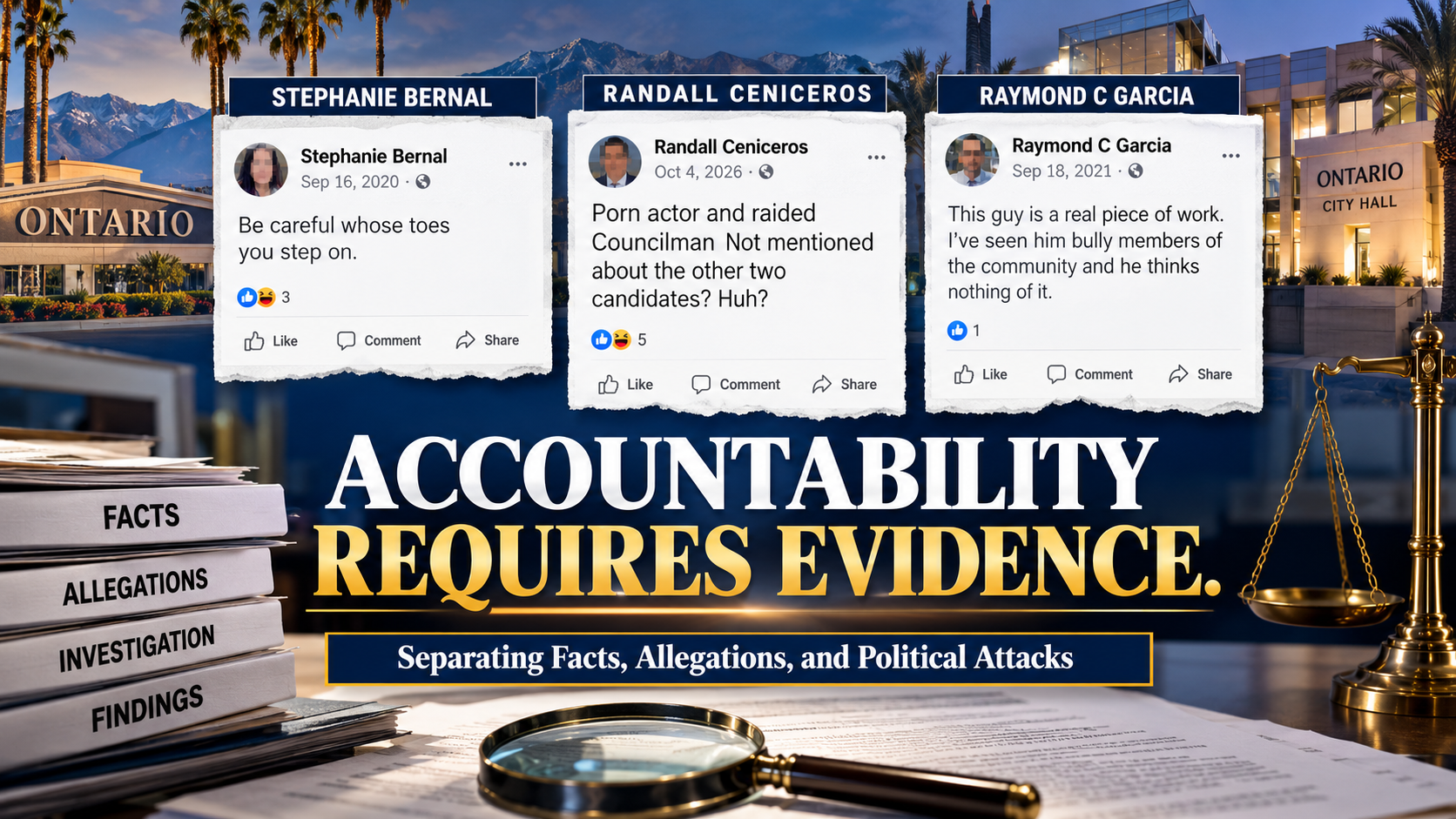
Accountability requires evidence. Repeating an accusation does not make it true. Filing a complaint does not establish misconduct. And holding public office does not place anyone above the standards of professionalism, integrity, and fairness.
By D'Andre D. Lampkin | October 30, 2026
Accountability requires evidence. Repeating an accusation does not make it true. Filing a complaint does not establish misconduct. And holding public office does not place anyone above the standards of professionalism, integrity, and fairness.
For more than a decade, I've dedicated myself to serving the City of Ontario through public safety, municipal planning, nonprofit leadership, neighborhood governance, and community partnerships.
Throughout that time, I've encountered residents with different opinions, competing priorities, and strong disagreements about local issues.
That's expected. Healthy disagreement is part of community leadership.
But there is an important distinction between holding someone accountable and repeatedly circulating personal accusations that have not been established through evidence.
As the 2026 election approaches, I've revisited public exchanges, formal complaints, and community disputes involving individuals whose names have surfaced in disagreements with me over the years.
Among them are Stephanie Bernal and Raymond Garcia, whose interactions with me date back several years.
More recently, public commentary by Mountain View School District Trustee Randall Ceniceros has raised additional questions about the judgment and professionalism we should expect from individuals entrusted with elected office.
The materials I've retained include Facebook exchanges dating back to September 2020, more recent Nextdoor discussions, video recordings, and complaints involving my professional responsibilities.
These experiences raise broader questions about how personal disagreements escalate, how allegations spread online, and why the public must distinguish an accusation from a substantiated finding.
Accountability should apply equally to those making allegations and those being required to defend themselves against them.
1. The Small-Pond Effect: How Repeated Allegations Can Distort Public Perception
One of the more troubling aspects of local political discourse is how a relatively small number of individuals can dominate conversations within neighborhood groups and online forums.
I think of this as the small-pond effect.
In a local community, the same accusation may circulate through Facebook, Nextdoor, political conversations, and neighborhood meetings.
When readers encounter similar claims repeatedly, they may begin to assume those claims have been independently established.
But repetition is not evidence.
Researchers have studied a related phenomenon known as the illusory truth effect, in which repeated exposure to information can increase its perceived credibility, even when that information is inaccurate.
A 2026 systematic review published in Nature Communications, examining 182 studies, found evidence that repetition can increase perceived truth, although the strength of the effect varies according to context.
This matters in local elections, where voters may encounter allegations about a candidate without examining the underlying documents or hearing a complete account of the events.
A small number of highly active participants can create the impression of widespread controversy without demonstrating that their allegations are accurate.
The number of times an allegation appears online does not determine whether it is true.
Repetition is not verification. Popularity is not proof. And an accusation does not become a fact simply because enough people repeat it.
That is why I encourage residents to examine original sources, distinguish firsthand evidence from speculation, and consider whether a claim has actually been substantiated.
2. Raymond Garcia: A Complaint That Ended in Exoneration
In 2021, Raymond Garcia submitted a complaint to the Los Angeles County Sheriff's Department concerning allegations arising from a Facebook discussion.
The matter underwent departmental administrative review.
Following command-level review, the final disposition was Exoneration, according to my firsthand knowledge of the corrected administrative disposition.
That final disposition was communicated to Garcia as the reporting party.
The corrected disposition identified two applicable grounds for exoneration.
No Personal Involvement
"The employee was not personally involved in or in any way connected to the incidents or alleged conduct."
Allegations Clearly False or Reporting Party Demonstrated Diminished Capacity
"Inquiry revealed that all allegations were clearly false or reporting party demonstrated diminished capacity."
Both criteria were checked on the corrected disposition, according to my firsthand account.
The second criterion contains alternative grounds and should not be interpreted as an independent medical or psychological finding about the reporting party.
The significance of the outcome is straightforward: the final administrative disposition was Exoneration.
This experience illustrates why complaints must be evaluated according to evidence and final findings rather than treated as proof of wrongdoing merely because someone submitted them.
I have no objection to legitimate complaints being investigated.
Public employees should be accountable for their conduct, and members of the community should have access to appropriate reporting processes.
But those processes should not become substitutes for evidence.
When someone makes an accusation involving another person's professional responsibilities, the outcome of the review matters just as much as the original allegation.
Credibility requires acknowledging both.
3. Stephanie Bernal: When an HOA Disagreement Escalates Beyond Community Governance
My experience with Stephanie Bernal concerns events extending beyond ordinary differences of opinion about neighborhood governance.
I have served on the Creekside West Homeowners Association Board of Directors for more than a decade.
That service includes making difficult decisions, supporting the professionals responsible for the association's operations, addressing residents' concerns, and fulfilling responsibilities established by our governing documents.
Not everyone agrees with those decisions.
That is part of serving on a board.
However, disagreements over HOA matters should be addressed through appropriate procedures and with respect for everyone involved.
The August 12, 2026 confrontation
On August 12, 2026, I witnessed an incident involving Bernal and our HOA property manager that escalated well beyond an ordinary disagreement.
During the confrontation, Bernal moved very close to the property manager and continued the exchange despite requests to disengage.
The property manager became visibly overwhelmed, distressed, and began crying.
I intervened because I believed the situation required immediate de-escalation and that the property manager deserved to carry out her responsibilities without being subjected to continued confrontation.
My involvement arose from my responsibilities as an HOA Board member, not from my employment as a Los Angeles County Deputy Sheriff.
The incident resulted in police involvement and subsequent actions concerning Bernal's participation in HOA meetings.
Formal HOA action and continuing meeting restrictions
Following the confrontation, the HOA took formal action concerning Bernal's ability to participate in association meetings.
I participated in establishing a meeting-attendance restriction involving the association's legal counsel.
As of October 30, 2026, that HOA meeting restriction remains in effect.
A separate police-related trespass notice issued during the dispute was subsequently rescinded. That action should not be confused with the HOA's continuing meeting-attendance restriction.
The distinction matters because the association's own governance response remains part of the history of these events.
This was not an action based on political disagreements or social media commentary. It was an association governance matter arising from events involving property management, security concerns, and conduct during HOA proceedings.
The restriction is an association action that I personally participated in establishing as a sitting board member.
4. The Debra Porada Connection: Political Statements During an HOA Confrontation
Another aspect of the August 12 confrontation raised concerns about the introduction of local political relationships into what should have remained an HOA governance matter.
During the incident, after the property manager became visibly distressed and I intervened, Bernal made a statement directly to me concerning Ontario Councilwoman Debra Porada.
Bernal told me that she and Councilwoman Porada were friends and that she intended to help Porada remove me from both the Creekside West HOA Board of Directors and the Ontario Planning Commission.
I personally heard this statement.
It was not something relayed to me through social media or another resident.
I found it particularly concerning because the disagreement arose from my HOA responsibilities, yet Bernal was referencing my appointed position in municipal government.
Her remarks introduced the possibility of political consequences into a private association dispute.
The distinction here is important.
Bernal's statement establishes what she represented to me about her relationship with Porada and her stated intentions.
It does not independently establish that Porada authorized, encouraged, knew about, or participated in any effort to remove me from either position.
Nevertheless, I believe the statement deserves documentation because it provides context for understanding my concerns about the subsequent escalation of the dispute.
From stated intentions to complaints involving my employment
My concerns intensified when matters involving my HOA service became the subject of complaints directed toward my Sheriff's Department employer.
The October 6, 2026 complaint was not an isolated occurrence.
According to my firsthand experience, this marked the third occasion on which Stephanie Bernal attempted to use the Los Angeles County Sheriff's Department's formal complaint process against me.
I believe these repeated actions were retaliatory responses to decisions I made while carrying out my responsibilities as a Creekside West HOA Board member.
My concern is particularly serious because the disagreements originated in HOA governance, where I serve as a board member, not in the performance of my law-enforcement duties.
The October 6 complaint included allegations concerning my professional authority and conduct associated with HOA matters.
I dispute those allegations.
The complaint's submission is documented. Its submission does not establish that the alleged conduct occurred.
I believe Bernal's decision to involve my Sheriff's Department employer was retaliatory and directly connected to decisions I made while fulfilling my responsibilities as an HOA Board member.
That conclusion is my interpretation of the circumstances, rather than an independently established administrative finding about her motivation.
My concern is heightened by information subsequently shared with me by a neighbor who reported attending a gathering at Archibald's restaurant.
According to that neighbor, Bernal discussed my candidacy for Ontario City Council and expressed an intention to use the election as an opportunity to remove me from the HOA Board, jeopardize my Sheriff's Department employment, and undermine my campaign.
I did not personally witness those reported remarks, and the account has not been independently corroborated.
Nevertheless, when considered alongside the statement Bernal made directly to me on August 12, I believe the reported account warrants further examination.
From my perspective, the complaints directed toward my employer were consistent with the objectives Bernal had expressed concerning my HOA and public-service positions.
This raises a serious concern about the potential misuse of a legitimate employee complaint process as an instrument of personal retaliation.
The public has every right to submit good-faith complaints about suspected misconduct. I fully support that right, particularly given my own professional responsibilities.
However, the mere submission of a complaint does not establish wrongdoing, and repeated complaints should be evaluated against their supporting evidence, underlying circumstances, and ultimate findings.
I believe the timing, frequency, and circumstances of these complaints deserve scrutiny.
No public servant should be immune from accountability.
But neither should someone have to fear repeated allegations against their professional employment simply because another person disagrees with decisions made while fulfilling separate community leadership responsibilities.
5. Recorded HOA Confrontations and the Responsibility to Respect Others
The August 12 incident was not the only confrontation involving Bernal that came to my attention.
Security personnel also reported a separate encounter involving Bernal, a resident, and a security officer responding to a request for assistance.
A witness provided me with video footage of that encounter.
According to the account provided to me, the incident included highly inflammatory accusations directed toward the security officer and others involved.
The witness's account and the footage raise concerns about how quickly disagreements can escalate when serious personal accusations are introduced.
The footage and surrounding circumstances should be examined in their entirety before attributing specific statements or conclusions to anyone.
What concerns me is the broader issue of conduct during community disagreements.
A resident seeking assistance from security personnel should be able to do so without unnecessary escalation.
Security officers and property management personnel should likewise be able to perform their responsibilities without becoming targets of unsupported personal accusations.
This applies equally to HOA Board members.
The right to criticize decisions or question authority does not eliminate the responsibility to respect appropriate boundaries.
Disagreement is legitimate. Personal confrontation and unsupported accusations are not substitutes for resolving the underlying issue.
6. A History That Predates the 2026 Election
My disagreements with Bernal did not begin during the current election.
Screenshots retained from September 2020 document Facebook exchanges involving community-group moderation, personal criticism, and discussions concerning LGBTQ representation.
In one exchange, Bernal wrote:
"Be careful whose toes you step on."
That statement is part of the documented conversation. Its meaning should be evaluated in context rather than automatically characterized as a threat.
What matters here is that the disagreements existed years before my 2026 City Council campaign.
The continuation of disputes over time does not, by itself, establish malicious intent.
But it does provide relevant context when considering claims about why certain conflicts emerged or escalated.
The public should understand that these disagreements have a longer history than the current election.
A political campaign should not erase that context.
Nor should political disagreements become opportunities to rewrite someone's history of service or professional conduct.
7. Randall Ceniceros: The Maturity and Judgment Expected of Elected Officials
In October 2026, another social media exchange raised concerns about the professionalism demonstrated by someone already holding elected office.
Randall Ceniceros serves as the Trustee Area 2 representative on the Mountain View School District Board of Trustees.
In a social media discussion, Ceniceros wrote:
"Porn actor and raided Councilman Not mentioned about the other two candidates? Huh?"
I understood the reference to a "porn actor" as directed at me.
My professional history includes years of modeling, commercial advertising, television, and independent film.
Among those credits is Toeing the Line, an LGBTQ dramatic short film in which I portrayed Lamar.
The film is publicly listed by its distributor, Here TV, as an LGBTQ drama.
Participating in an LGBTQ dramatic production does not make someone a pornography actor.
I reject the characterization as an inaccurate description of my professional work.
What concerns me most, however, is the judgment demonstrated by someone already entrusted with elected public office.
I previously attended a political forum where concerns about negative campaign mailers were discussed.
My recollection is that attendees were encouraged to research allegations independently rather than automatically accept political advertising at face value.
That is sound advice.
I believe elected officials should apply that same standard to their own statements.
In my opinion, the comment demonstrates the kind of immaturity and poor judgment that should concern residents when evaluating the people entrusted with public leadership.
An elected official should understand the difference between substantive criticism and a disparaging label.
Leadership requires more than winning an election or holding a title.
It requires restraint, intellectual honesty, sound judgment, and the maturity to recognize that words have consequences.
School board trustees occupy positions of public trust. They help establish the priorities of institutions responsible for educating young people.
I believe those responsibilities call for an especially thoughtful approach to public discourse.
Ceniceros is entitled to his political opinions, including disagreement with my candidacy.
But his public commentary is also subject to scrutiny.
Maturity in leadership is not demonstrated by how effectively someone insults another person.
It is demonstrated by whether they can engage in disagreement without abandoning fairness, accuracy, and professionalism.
My qualifications and career history are publicly documented.
I welcome their examination.
What I question is the judgment of an elected official who appears willing to substitute a derogatory characterization for a substantive discussion of those qualifications.
If we expect professionalism and accountability from those seeking public office, we should expect the same from individuals who already hold it.
8. Search Engines Don't Verify Every Claim
There is another reason this subject deserves attention.
In today's information environment, someone's public reputation can be influenced by material appearing in search results.
A person might search a candidate's name and encounter social media accusations, complaints, political commentary, or opinion pieces.
But appearing in search results does not establish that a claim is true.
Search engines use complex ranking systems to organize information. They are not substitutes for independent investigations or official findings.
An unsupported accusation can appear in search results.
So can a correction.
So can a documented finding that contradicts an earlier allegation.
Unfortunately, readers do not always examine competing sources with the same level of scrutiny.
A politically convenient accusation can spread quickly, particularly when it is repeated across neighborhood groups and political discussions.
A correction may never receive comparable attention.
That imbalance can have serious consequences for people's professional reputations and for the quality of civic debate.
Search visibility is not credibility. Evidence is.
That principle should apply to statements made about candidates, public officials, HOA Board members, employees, and ordinary residents alike.
And it is why I believe anyone making a serious allegation should be prepared to support it with documentation rather than relying on repetition.
9. The Difference Between Accountability and Personal Retaliation
I have spent much of my professional career in environments where accountability is essential.
As a Deputy Sheriff, emergency management professional, Planning Commissioner, nonprofit leader, business executive, and HOA Board member, I understand that decisions can be questioned and actions can be reviewed.
I do not consider myself exempt from scrutiny.
In fact, I believe people entrusted with leadership should welcome reasonable questions about how they exercise authority.
But accountability is not simply the ability to accuse someone.
It requires a commitment to establishing what actually happened.
That means giving appropriate weight to documents, witness accounts, applicable policies, independent findings, and the responses of those involved.
It also means recognizing the difference between an allegation that has been substantiated and one that has not.
When disputes involve neighborhood politics, personal relationships, or competing interests, those distinctions become even more important.
People can disagree without acting dishonestly.
They can submit complaints in good faith that are ultimately unsupported.
And they can make mistakes without those mistakes establishing a broader pattern of misconduct.
What deserves scrutiny is whether allegations are being presented accurately and whether the individuals making them acknowledge credible information that contradicts their claims.
Accountability cannot be a one-way street.
The standards demanded of public servants should also inform how residents, elected officials, and political participants conduct themselves.
10. Leadership Requires the Courage to Make Difficult Decisions
One thing these experiences have reinforced is why I believe I'm prepared to serve as an Ontario City Councilmember.
Leadership isn't about making decisions that keep everyone happy. It's about having the judgment, courage, and integrity to do what's right, even when doing so is unpopular.
I've never been uncomfortable disagreeing with someone.
I believe people deserve to be heard, their concerns deserve thoughtful consideration, and disagreements should be resolved through reasonable, fair, and consistent decision-making.
But listening to someone doesn't mean I must agree with them.
And disagreeing with someone doesn't mean I've failed to serve them.
Throughout my years in public safety, municipal planning, emergency management, and community leadership, I've learned that difficult decisions are unavoidable.
Sometimes those decisions disappoint friends, upset supporters, or invite criticism from people who would prefer a different outcome.
I will not allow the threat of retaliation, the possibility of losing someone's political support, or concerns about my personal popularity to determine whether I fulfill my responsibilities.
That's not arrogance.
That's an understanding of what public service requires.
As a Planning Commissioner and HOA Board member, I've had to evaluate competing interests, weigh evidence, consider applicable rules, and make decisions that affect other people's lives and property.
Those decisions deserve to be made fairly, not according to personal relationships or political pressure.
I recognize that every decision I make will not satisfy everyone.
But every resident deserves confidence that I will listen, apply consistent standards, and act according to what I believe the evidence and my responsibilities require.
That is precisely the independence of judgment I intend to bring to the Ontario City Council.
Ontario doesn't need leaders who change their positions every time someone threatens to withdraw support.
It needs leaders willing to make responsible decisions, explain them, and remain accountable for the results.
I am willing to change my mind when credible evidence justifies doing so.
What I will not do is abandon a fair and reasonable decision simply because someone dislikes the outcome or threatens consequences.
There is a difference between being unwilling to compromise and being unwilling to compromise your principles.
My commitment is simple:
Do what's right. Follow the facts. Apply the same standards regardless of who's involved.
That's how I've approached public service for years, and that's how I intend to continue serving Ontario.
11. Why I'm Choosing to Document These Experiences
I've thought carefully about whether to address these matters publicly.
My preference has always been to focus on the work itself: serving residents, supporting students, preparing communities for emergencies, strengthening neighborhood relationships, and addressing issues affecting Ontario.
That work has continued for years, regardless of whether an election was approaching.
But I also believe there is value in maintaining an accurate public record when allegations involving someone's professional conduct become part of public discussion.
The purpose of documenting these experiences is not to deny anyone's right to criticize me.
It is to ensure that readers can distinguish between what someone alleged, what the available evidence establishes, and what remains unresolved.
I will continue to preserve original communications, formal records, and relevant findings.
I will also continue to challenge statements about my conduct when I believe those statements are unsupported or inaccurate.
My professional qualifications, public-service record, and commitment to this community deserve to be evaluated on their merits.
They should not be defined by the mere existence of disagreements or complaints.
And I believe everyone involved in these exchanges should be prepared to have their statements evaluated against the same standard of accuracy they expect from others.
12. The Bottom Line: Ontario Deserves Better
As we approach November 3, I want residents to remember something important.
The quality of our civic conversations matters.
A healthy community does not require everyone to agree.
It requires people to disagree responsibly.
It requires public officials to answer legitimate questions.
It requires residents to support serious allegations with evidence.
And it requires all of us to understand that repeating an accusation does not make it an established fact.
I've spent years building relationships with people throughout Ontario, including individuals who do not share my opinions.
Those relationships have taught me that meaningful service is not about winning every disagreement.
It is about remaining committed to the people and responsibilities entrusted to you.
I will continue to defend my professional reputation when necessary, just as I will continue to support residents' right to demand transparency and accountability.
But I refuse to allow personal disagreements to define the work I've done or the communities I've served.
The existence of an accusation is not proof of misconduct. The volume of someone's criticism is not a measure of its accuracy. And a person's credibility should ultimately rest on what the evidence supports.
Ontario deserves an informed electorate, constructive public debate, and leadership that remains focused on the work that matters.
And above all, Ontario deserves leaders who are willing to stand by reasonable, evidence-based decisions regardless of whether doing so is politically convenient.
I don't measure the quality of my leadership by how many people agree with every decision I make.
I measure it by whether those decisions are fair, responsible, supported by evidence, and made in the best interests of the people I'm entrusted to serve.
That has been my commitment for more than a decade.
And it will remain my commitment long after this election.
Real leadership shows up long before election season. And accountability must apply to everyone.
D'Andre D. Lampkin is a candidate for Ontario City Council, District 3.
Paid for by Lampkin for Ontario City Council 2026. FPPC ID #1494106.
Explore Topics
Written by
D'Andre D. Lampkin
Content creator and writer sharing insights and stories.