
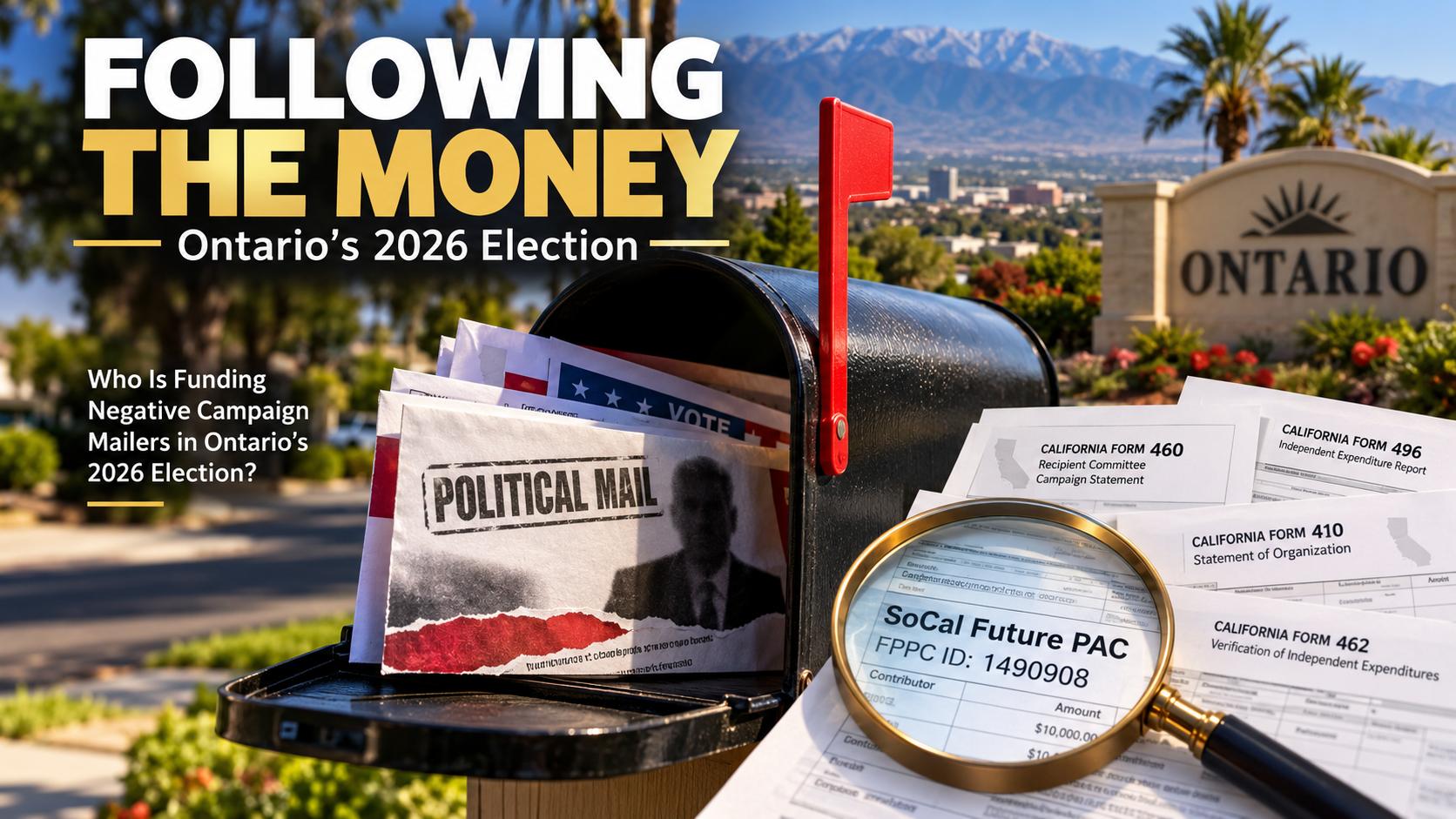
As negative political advertising reaches Ontario mailboxes, questions surrounding SoCal Future PAC's campaign expenditures and disclosure information deserve closer examination.
With Election Day approaching on November 3, Ontario residents are being asked to make important decisions about the future of our city.
They are also being exposed to one of the most contentious campaign environments in recent local memory.
Rather than focusing exclusively on housing, public safety, traffic congestion, infrastructure, economic development, and the challenges facing Ontario families, portions of this election have become increasingly dominated by negative political advertising.
I have always believed candidates should expect scrutiny. Our records, qualifications, decisions, and proposals should be examined carefully by the people we hope to represent.
But when political organizations spend thousands of dollars distributing negative campaign material, residents deserve to know who is financing those communications and whether the information being presented is accurate.
That is why I began examining the financial disclosures and identifying information associated with a negative campaign mailer targeting my candidacy for Ontario City Council District 3.
What I discovered has raised questions that I believe deserve public attention.
1. Following the Money Behind the Mailers
One of the organizations drawing attention during this election is SoCal Future PAC, a political committee that identifies itself under California Fair Political Practices Commission identification number 1490908.
Public campaign finance materials brought to my attention describe independent expenditures associated with the 2026 Ontario municipal election.
Among the expenditures identified for further verification are:
| Reported political activity | Amount |
|---|---|
| Expenditure opposing D'Andre Lampkin, City Council District 3 | $8,661 |
| Expenditure supporting Stephanie Martinez, mayoral candidate | $7,439 |
| Combined reported amount | $16,100 |
These figures are drawn from materials under review and should be reconciled against the original campaign-finance filings before being treated as a confirmed total.
Bullseye Marketing has also been identified in the materials as a reported vendor associated with political communications.
The precise transactions, payment dates, and relationship between the expenditures and the vendor require confirmation through the committee's original financial disclosures.
Political spending is not inherently improper. California law permits qualifying political committees to make independent expenditures supporting or opposing candidates.
Nevertheless, the public has a legitimate interest in understanding who is spending money to influence local elections.
An independent expenditure is, by definition, spending made without prohibited coordination with the candidate or campaign benefiting from it. The existence of such spending does not establish that a candidate requested, directed, or controlled the communication.
The important question is what the public records actually establish.
2. Who Is Financing SoCal Future PAC?
The financial records discussed in connection with SoCal Future PAC also identify reported contributions that warrant examination.
Two reported contributions are:
- John McGraw — $10,000
- Inland Harborcom — $10,000
These reported amounts require verification against the original Form 460 contribution schedules, including the correct contributor identities, transaction dates, and applicable reporting periods.
Contributors have the right to participate in the political process within the law. Making a campaign contribution does not establish wrongdoing or improper influence.
But financial transparency serves an important democratic purpose.
When residents receive campaign materials attempting to influence their votes, they should be able to trace the organizations financing those communications through publicly available disclosures.
That is especially important in municipal elections, where decisions concerning development, infrastructure, public safety, land use, and public resources have long-term consequences for residents.
Transparency should not end with identifying the organization named on a mailer. It should extend to the public records that explain how the organization is funded.
3. The Political Mailer Targeting My Campaign
During this election, residents shared photographs of a negative political mailer targeting my candidacy.
The material included allegations about me and reportedly referenced information described as an official police report.
My concern is not that a political opponent or independent committee chose to criticize me.
I have served in public-facing leadership roles for years. I understand that public scrutiny comes with those responsibilities, and I welcome legitimate questions about my record.
However, when a political advertisement relies on documents, allegations, or excerpts presented as official information, accuracy and context matter.
A police report may document that an allegation was made, an incident was reported, or an officer recorded certain information. Its existence does not automatically establish the truth of every statement appearing in it.
Likewise, an allegation is not equivalent to a finding of misconduct.
Voters deserve enough context to distinguish documented facts from accusations and political interpretations.
That standard should apply to every candidate, regardless of political affiliation, personal relationships, or campaign strategy.
Understanding the Allegations in the Mailer Targeting D'Andre Lampkin
Residents searching for information about the negative campaign mailer targeting my candidacy deserve a clear, factual account of what the advertisement reportedly contained and what the available records do and do not establish.
The mailer reportedly included allegations describing me in connection with pornography and sexual assault. These are serious allegations, and they deserve a serious, accurate response — not a political one.
What the mailer reportedly claimed: According to residents who shared photographs of the advertisement, the mailer included references characterizing me as a "porn star" and included material described as drawn from a police report.
What a police report establishes: A police report documents that an allegation was made, that an incident was reported, or that an officer recorded certain information. The existence of a police report does not establish that the events described in it occurred, that the allegations were investigated and sustained, or that any finding of misconduct was made. An allegation appearing in a police report is not equivalent to a criminal charge, a conviction, or an official determination of wrongdoing.
What I can confirm: I am not a pornographic performer. I have not been charged with or convicted of sexual assault. No regulatory or law enforcement agency has issued a finding of misconduct against me in connection with the allegations described in the mailer.
What remains subject to verification: The campaign is continuing to review the original mailer and the documents referenced in it. The precise wording of the advertisement, the source documents cited, and the context in which the allegations were presented require careful examination before further conclusions can be drawn. Documented responses and relevant records will be made available as they are authenticated.
Why this matters: Political advertising is permitted to be critical. It is not permitted to mislead voters about the factual basis for its claims. When an advertisement presents allegations drawn from a police report as though they constitute established facts, voters deserve to understand the difference. The standard I am applying to this mailer is the same standard I would apply to any political advertisement targeting any candidate: claims should be traceable to reliable evidence, and the distinction between an allegation and a finding should be made clear.
I welcome scrutiny of my record. I ask only that scrutiny be grounded in evidence rather than in the political interests of the organizations financing the advertising.
4. Examining the Financial Disclosures
To better understand the organization associated with the mailer, I began reviewing California's campaign finance disclosure system.
Several documents are particularly relevant:
Form 410 — Statement of Organization
This document provides identifying information about a political committee, including its official name, registration information, and designated officers.
Form 460 — Recipient Committee Campaign Statement
This document reports qualifying contributions, expenditures, and other financial activity during the applicable reporting period.
Form 496 — Independent Expenditure Report
This document reports qualifying independent expenditures made to support or oppose candidates or ballot measures.
Form 462 — Verification of Independent Expenditures
This verification addresses the independence of certain expenditures, including applicable representations concerning coordination.
Together, these records help residents trace political money, evaluate campaign advertising, and distinguish expenditures made by candidates from those made by outside committees.
They also provide a basis for examining discrepancies when campaign advertising and official records do not appear to align.
5. Why Did the Negative Mailer Display a Different FPPC Number?
One of the most concerning issues I identified involves the committee identification number displayed on the negative campaign mailer.
The mailer reportedly displayed a number that did not match the registered identification number associated with SoCal Future PAC.
The discrepancy is straightforward:
| Identification source | Number |
|---|---|
| SoCal Future PAC's reported registered FPPC number | 1490908 |
| Number appearing on the negative mailer | 146302 |
On Friday, October 9, 2026, I contacted the California Secretary of State's Political Reform Division to seek clarification.
During that conversation, a representative confirmed that 1490908 was a valid committee identification number. When I provided the number appearing on the mailer, the representative indicated that the number was too short to be a complete FPPC committee identification number.
The representative recommended that I contact the San Bernardino County District Attorney's Office regarding my concerns.
That recommendation should not be confused with a determination that any law was violated or that a government investigation had been opened.
Was the incorrect number intentional?
Initially, I considered whether the discrepancy could have been a simple printing error.
Mistakes can happen, particularly during the production and distribution of political advertising.
However, after examining the information available to me and contacting the Secretary of State, I have growing concerns that the discrepancy may not have been accidental.
I want to be precise about what that means.
I believe the possibility that the incorrect number was intentional deserves examination. I am not claiming to have established anyone's intent.
The distinction matters because California generally does not require a political committee's FPPC identification number to appear on a campaign mass mailing. The FPPC recommends identifying the committee, but an incorrect identification number, by itself, does not establish a violation of the Political Reform Act.
The broader disclosure requirements, including the accurate identification of the committee responsible for certain political advertisements, remain important.
That leaves several reasonable questions:
- Why was a number different from the committee's registered identification number printed on the mailer?
- Was the discrepancy a production error, or was the number supplied incorrectly?
- Did the organization responsible for the mailer review the identification information before distribution?
- Has the committee identified or corrected the discrepancy?
- Were the remaining legally required disclosures accurate and complete?
These questions are not accusations of criminal conduct. They are questions about accountability and the accuracy of information voluntarily presented to voters.
If the number was simply a mistake, a straightforward explanation could resolve the issue.
If there is another explanation, the public deserves an opportunity to understand it.
When political organizations ask voters to trust the claims appearing in their advertisements, they should also be prepared to explain discrepancies in the identifying information they provide.
6. Seeking Clarification Through the Appropriate Channels
My efforts to examine the mailer have not been limited to social media discussions.
On October 9, I contacted the California Secretary of State's Political Reform Division and discussed the identification information appearing on the advertisement.
I also requested relevant committee registration records to better understand the organization's official status and disclosures.
My purpose in seeking those records is straightforward: I want to understand what the documents establish before drawing conclusions.
There is a difference between raising a question, filing a complaint, and receiving an official determination from a regulatory or prosecutorial agency.
I am not representing that the California Secretary of State, Fair Political Practices Commission, or San Bernardino County District Attorney's Office has concluded that misconduct occurred.
Nor am I suggesting that an agency recommendation to contact another office constitutes a formal finding or enforcement action.
Any such determination belongs to the appropriate authorities.
My responsibility is to present my concerns accurately and preserve the supporting information.
7. Why This Matters Beyond My Campaign
Although the mailer targeted me, the broader issue extends beyond one candidate or one election.
Ontario is experiencing significant growth and change.
Residents are asking legitimate questions about the future of their neighborhoods, housing affordability, traffic congestion, public safety, development, parks, infrastructure, and the financial decisions made at City Hall.
Those issues deserve serious consideration.
Political advertising is part of our democratic process, and organizations have the right to advocate for their preferred candidates and policies within the law.
But voters should not have to rely exclusively on the claims appearing in campaign materials.
They should be able to examine the public record and make their own judgments.
That includes understanding the differences between a candidate's campaign expenditures, independent political expenditures, and contributions to outside committees.
Financial transparency does not require voters to agree with one another.
It simply provides everyone with access to information relevant to the decisions they are being asked to make.
8. Our Campaign Has Chosen a Different Approach
From the beginning, I made a conscious decision that this campaign would focus on what I bring to Ontario, rather than how effectively I could tear down another candidate.
For more than a decade, I have worked alongside residents, community organizations, young people, public safety professionals, and local stakeholders to strengthen our community.
Through my community service, nonprofit leadership, public safety career, and work as an Ontario Planning Commissioner, I have had opportunities to listen to residents, confront difficult challenges, and help move meaningful projects forward.
That record existed long before my name appeared on a ballot.
And it will continue to matter long after Election Day.
I welcome scrutiny of my record. I welcome difficult questions. And I believe every candidate and political committee should be held to the same standard of transparency.
But voters deserve better than a political environment where personal attacks drown out meaningful conversations about the future of our city.
We should be discussing how to make growth pay for growth.
We should be discussing infrastructure that keeps pace with development.
We should be discussing emergency preparedness, responsible fiscal management, safer streets, neighborhood preservation, and the opportunities our young people will have in the years ahead.
Those are the conversations I have consistently sought to bring into this campaign.
Real leadership shows up long before election season.
I believe the character of a campaign tells voters something about how its participants approach leadership.
I also believe the people of Ontario are capable of examining competing claims, recognizing the difference between allegations and evidence, and making informed decisions.
9. What Residents Can Do Before November 3
As voters receive campaign materials during these final days before the election, I encourage them to examine the information carefully.
Ask who paid for the communication.
Consider whether the claims are supported by evidence.
Review publicly available campaign finance reports when questions arise about political spending.
Most importantly, evaluate the candidates based on their qualifications, judgment, community involvement, policy priorities, and demonstrated record of service.
Residents can access campaign disclosure information through the following public resources:
California Fair Political Practices Commission
https://www.fppc.ca.gov
City of Ontario Campaign Finance Disclosure Portal
https://netfile.com/public/ONT/campaign
SoCal Future PAC
https://www.socalfuturepac.org
Additional original documents and relevant responses will be made available as they are authenticated.
10. Real Change Begins With Voters
Throughout this campaign, residents have told me they want something different for Ontario.
They want leaders who listen.
They want accountability.
They want a City Council that focuses on the long-term needs of neighborhoods rather than the short-term demands of political campaigns.
But meaningful change requires more than dissatisfaction with the current political environment.
It requires participation.
It requires residents to examine the choices before them and take the important step of casting their ballots.
On November 3, voters will decide who represents Ontario City Council District 3.
I hope that decision is based on evidence, qualifications, experience, and a clear vision for the future.
Ontario's future will not be decided by who sends the most negative mailers. It will be decided by residents who take the time to examine the facts, consider the records of those seeking office, and cast their ballots.
My commitment remains the same as it was when this campaign began: to serve Ontario with integrity, transparency, preparation, and a willingness to bring people together.
Real leadership shows up long before election season.
And real change begins when voters choose the kind of leadership they want to see.
Editor's transparency note: The expenditure amounts, contributions, and vendor references described in this article remain subject to reconciliation against original campaign-finance filings. The committee identification discrepancy is presented as a matter requiring an explanation, not as a finding of intentional wrongdoing or a legal violation. The campaign welcomes documented corrections and responses from the parties identified.
D'Andre Lampkin
Candidate, Ontario City Council District 3
www.lampkinforontario.org
Paid for by Lampkin for Ontario City Council 2026. FPPC ID #1494106
Explore Topics
Written by
D'Andre Lampkin
Content creator and writer sharing insights and stories.