As Ontario approaches its historic District 3 election, D'Andre Lampkin examines political influence, proven leadership, responsible growth, and the question of who will truly be represented after November 3.
Throughout this campaign, I've listened to residents who are frustrated by the direction of local politics. They want leadership that listens, accountability that extends beyond election season, and a City Council that remembers whom it represents.
At the same time, substantial resources are being spent to influence how residents view the candidates seeking office.
I've watched negative campaign mailers arrive in neighborhoods, public accusations circulate online, and political conversations become increasingly focused on personalities rather than the issues that will determine Ontario's future.
But with November 3 approaching, I've been thinking about a much larger question.
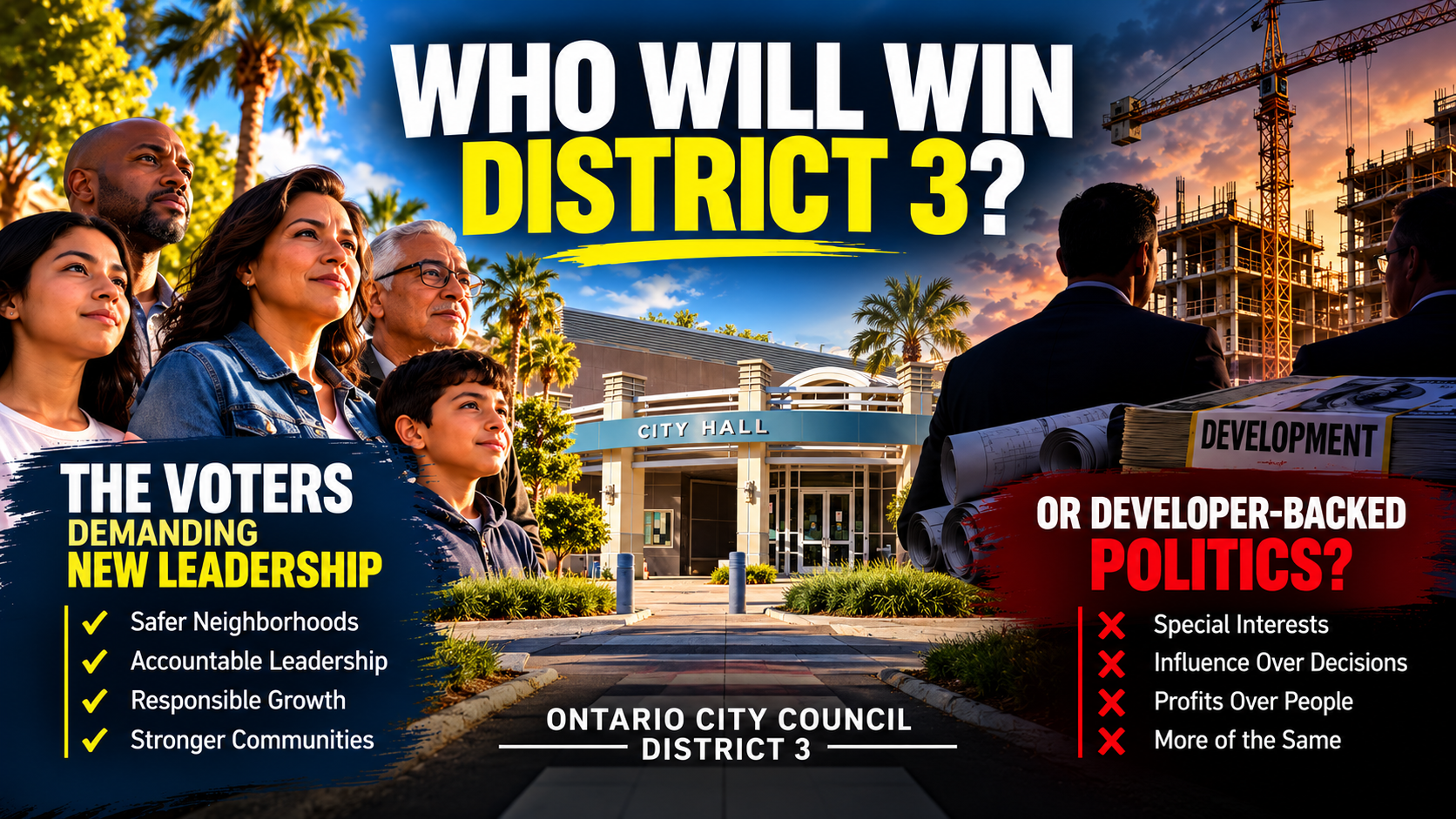
Who will actually win this election?
Will it be the residents of District 3 who are demanding new leadership, independent judgment, and meaningful accountability?
Or will established political relationships and powerful financial interests continue to shape who governs Ontario and whose priorities receive the greatest attention?
The answer matters far beyond any one campaign.
For the First Time, District 3 Gets to Decide
This is not an ordinary local election.
For the first time in Ontario's history, District 3 residents will elect their own dedicated representative to the City Council. Historically, Council members were elected at large — meaning the entire city voted on every seat, and no single district had its own voice at the table.
Under the city's transition to district-based elections, that changes now. District 3 residents will choose someone specifically accountable to their neighborhoods, their concerns, and their future.
You can review the City's official election information at ontarioca.gov.
I've written more about the significance of this transition in a previous article: For the First Time, District 3 Will Choose Its Own Councilmember.
This new seat does not belong to any political faction, incumbent, development interest, or presumed successor.
District 3 is not a political inheritance. It is not a reward for years spent within the political establishment. And it is not a position that any financial interest should presume it can control.
It belongs to the people who live here.
When Money Enters an Election, Residents Deserve Transparency
Political contributions and independent expenditures are a legitimate part of the electoral process when conducted in compliance with applicable law. I want to be clear about that.
But residents have a right to know who is financing political communications and how those organizations are connected to the issues confronting Ontario.
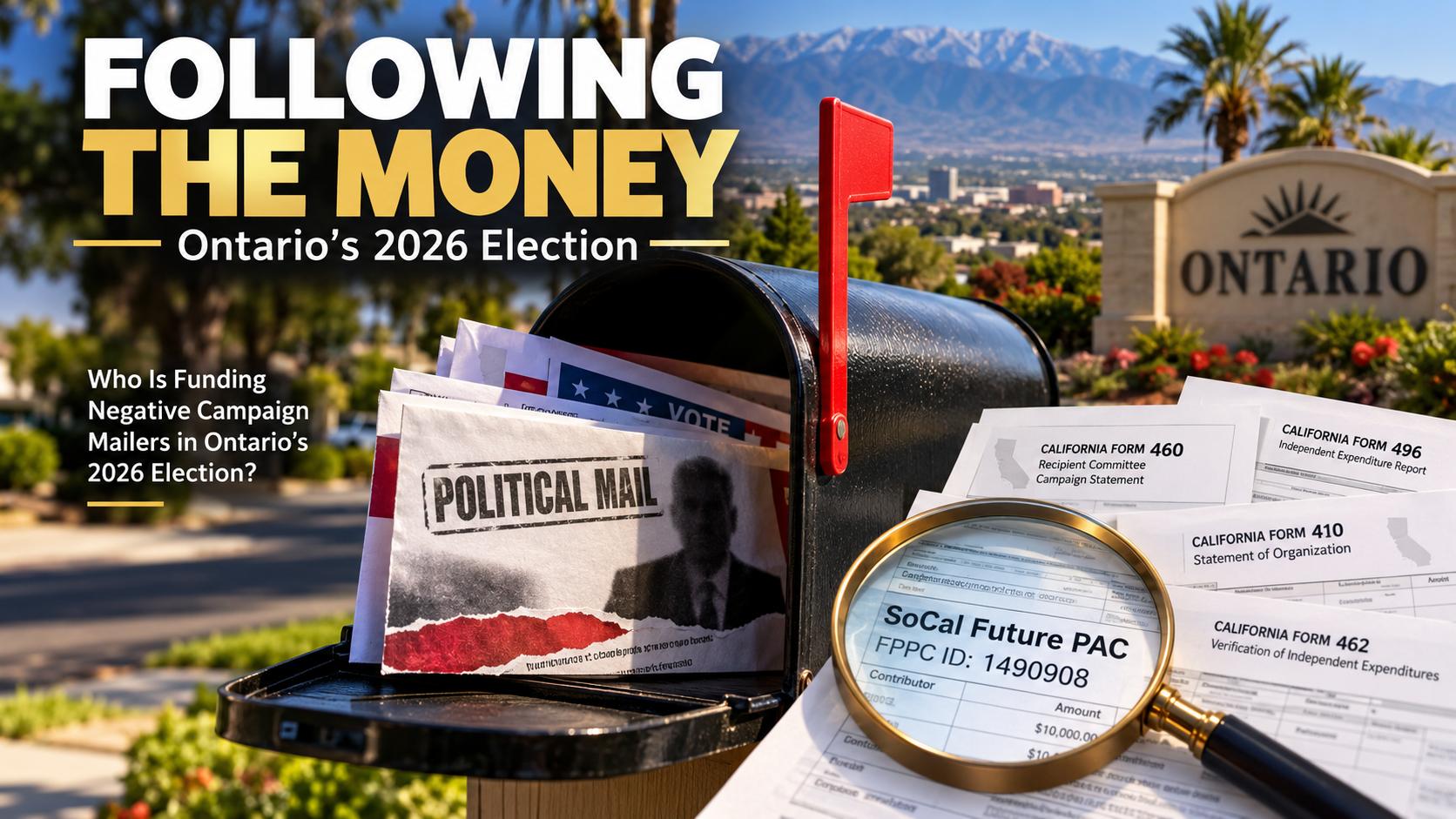
I've already examined some of those questions in detail: Following the Money: Who Is Funding Negative Campaign Mailers in Ontario's 2026 Election?
My concern about political mailers is not simply the criticism directed toward my candidacy. The broader issue is transparency, accuracy, and the responsibility to support public allegations with evidence.
It is also important to be precise: independent expenditure spending does not, by itself, establish coordination with a candidate, corruption, or improper influence. Making a campaign contribution is not evidence of wrongdoing. Political organizations have the right to participate in elections within the law.
But voters have every right to ask whether the interests financing political messages align with the interests of the families who will live with the consequences of the decisions made at City Hall.
"There is nothing inherently wrong with a developer contributing to a political campaign, participating in public discussions, or advocating for policies that affect their investments.
But voters have every right to ask whether the interests financing political messages align with the interests of the families who will live with the consequences of the decisions made at City Hall."
Residents can review campaign finance disclosures directly at the City of Ontario Campaign Finance Disclosure Portal.
Ontario Needs Development. It Also Needs Independent Leadership.
I want to be direct about something that sometimes gets lost in political campaigns: development is not the enemy.
Ontario needs responsible investment. It needs housing, employment centers, infrastructure, commercial opportunities, and businesses that generate recurring revenue for the city. As an Ontario Planning Commissioner, I have participated in the planning process and I understand the importance of private investment to our city's long-term health.
Development proposals must be evaluated in accordance with applicable General Plan policies, specific plans, zoning requirements, environmental review, infrastructure considerations, and other governing laws. These are not matters of personal preference. City Council members must sometimes apply legally established standards even when particular projects are controversial, and the Council's policy-setting role is distinct from the quasi-judicial responsibilities that can arise in certain land-use proceedings.
None of that changes the fundamental principle I have held throughout my public service:
"I am not opposed to development. I am opposed to the idea that any developer, donor, political organization, or influential individual should receive preferential treatment at the expense of the people who call Ontario home.
Good development benefits the city.
Good leadership ensures those benefits do not come at an unreasonable cost to our neighborhoods."
Growth should help pay for the infrastructure and services that growth requires. That means addressing truck traffic, roadway capacity, emergency response, public safety, neighborhood compatibility, housing needs, and long-term fiscal responsibility — not simply approving projects and leaving residents to absorb the consequences.
I've written more about this in Ontario's Housing Progress Deserves a Place in the Development Conversation.
Leadership That Wasn't Built Around an Election
My public service record extends well beyond my appointment to the Ontario Planning Commission.
Over the course of my career, I have served in public safety and law enforcement, homeland security and emergency management, healthcare leadership, disaster preparedness and community resilience, youth mentorship and entrepreneurship, nonprofit and community service, regional coordination and interagency leadership, and municipal planning and land-use review.
Through the D'Andre D. Lampkin Foundation, I have worked to strengthen communities, support families, develop young leaders, and prepare people for emergencies. That work began long before this campaign and will continue long after it.
You can read more about that record here:
"Being appointed to the Ontario Planning Commission allowed me to contribute to our city in another important capacity.
But it did not create my record of service.
My experience in leadership, emergency management, public safety, healthcare, community development, and regional collaboration existed independently of that appointment.
I didn't wait for a seat at City Hall to begin serving the people of Ontario.
And I am not seeking that seat to serve someone else's political or financial agenda."
The stronger measure of any candidate is not what they promise during a campaign. It is what they have already demonstrated through their actions.
What This Election Has Revealed About Our Political Culture
This campaign has exposed something that many residents already suspected: our local political culture has real problems.
Negative mailers have arrived in neighborhoods. Accusations have circulated online. Campaign sign disputes have drawn public attention. Political spending has shaped the conversation in ways that have little to do with the issues residents actually care about.
I have chosen to spend much of this campaign differently — holding Community Conversations, visiting neighborhoods, answering difficult questions, working with local organizations, and remaining accessible to residents who want to talk about the future of District 3.
Disagreements and vigorous debate are essential to democracy. I am not suggesting that campaigns should be free of criticism or that difficult questions should be avoided.
But political campaigns should not reward misinformation or discourage residents from participating.
"I have watched residents express frustration with the tone of this election.
Some have told me they want change, but they are also tired of the tactics being used to influence their decisions.
I understand that frustration.
But meaningful change will require more than rejecting a negative mailer or expressing disappointment on social media.
It will require residents to make a decision about what kind of political culture they are willing to accept."
The Real Test Begins After November 3
Elections are not the conclusion of public accountability. They are the beginning of it.
The elected representative for District 3 will be responsible for decisions involving infrastructure, development, public safety, municipal finances, and the long-term future of our neighborhoods. Those decisions will involve real money, real consequences, and real tradeoffs that affect the quality of life residents experience every day.
Residents should evaluate candidates not only by campaign messaging, but by their qualifications, decision-making experience, independence, and demonstrated willingness to communicate with constituents.
"November 3 will determine who occupies the District 3 seat.
But what happens afterward will determine whether this election truly changed anything.
The person elected will face decisions affecting millions of dollars in investment, the direction of our neighborhoods, and the quality of life residents experience every day.
Those decisions will reveal what priorities matter.
They will also reveal whether the promises made during this election were genuine commitments or simply words designed to secure votes."
Voters Must Decide What They Are Willing to Accept
Expressing support for change is not the same as participating in an election.
Residents who want a different approach to leadership must take the step of voting. That means verifying your registration, reviewing candidate records, understanding the issues, and casting your ballot by November 3, 2026.
Official voting information is available through the City of Ontario and the San Bernardino County Registrar of Voters.
"Many residents have told me that Ontario needs change.
I appreciate those sentiments.
But change does not happen simply because we believe it should.
It happens when people become informed, participate, and use the power they already possess.
An election belongs to the voters only when the voters exercise that power."
So, Who Will Win District 3?
On November 3, District 3 voters will make history.
For the first time, they will elect someone specifically to represent their neighborhoods on the Ontario City Council.
Some will evaluate the candidates based on political endorsements. Others will examine campaign financing, professional qualifications, community relationships, and records of public service.
I hope every voter will consider the question that has guided much of my own public service:
Who has demonstrated the judgment, independence, preparation, and willingness to serve that this responsibility requires?
I have spent years showing what leadership means without needing an elected title. My record was not created for this election, and my commitment to Ontario will not disappear when this election ends.
I believe residents deserve a representative who understands that responsible development and the interests of the community must work together, and that no financial or political relationship should take precedence over the public interest.
The next four years will involve difficult decisions. District 3 deserves someone prepared to make them.
The real question isn't simply who wins on November 3. It's who will be represented for the next four years.
And that is a question every District 3 voter should take seriously.
Who Will Win District 3? features an illustrative composite image examining resident representation and political influence in Ontario's 2026 election. It does not depict actual political participants or a documentary photograph of City Hall.
Leadership Built on Service. A Vision Built for Ontario.
D'Andre D. Lampkin Candidate, Ontario City Council District 3 lampkinforontario.org
Paid for by Lampkin for Ontario City Council 2026. FPPC ID #1494106
Explore Topics
Written by
D'Andre D. Lampkin
Content creator and writer sharing insights and stories.