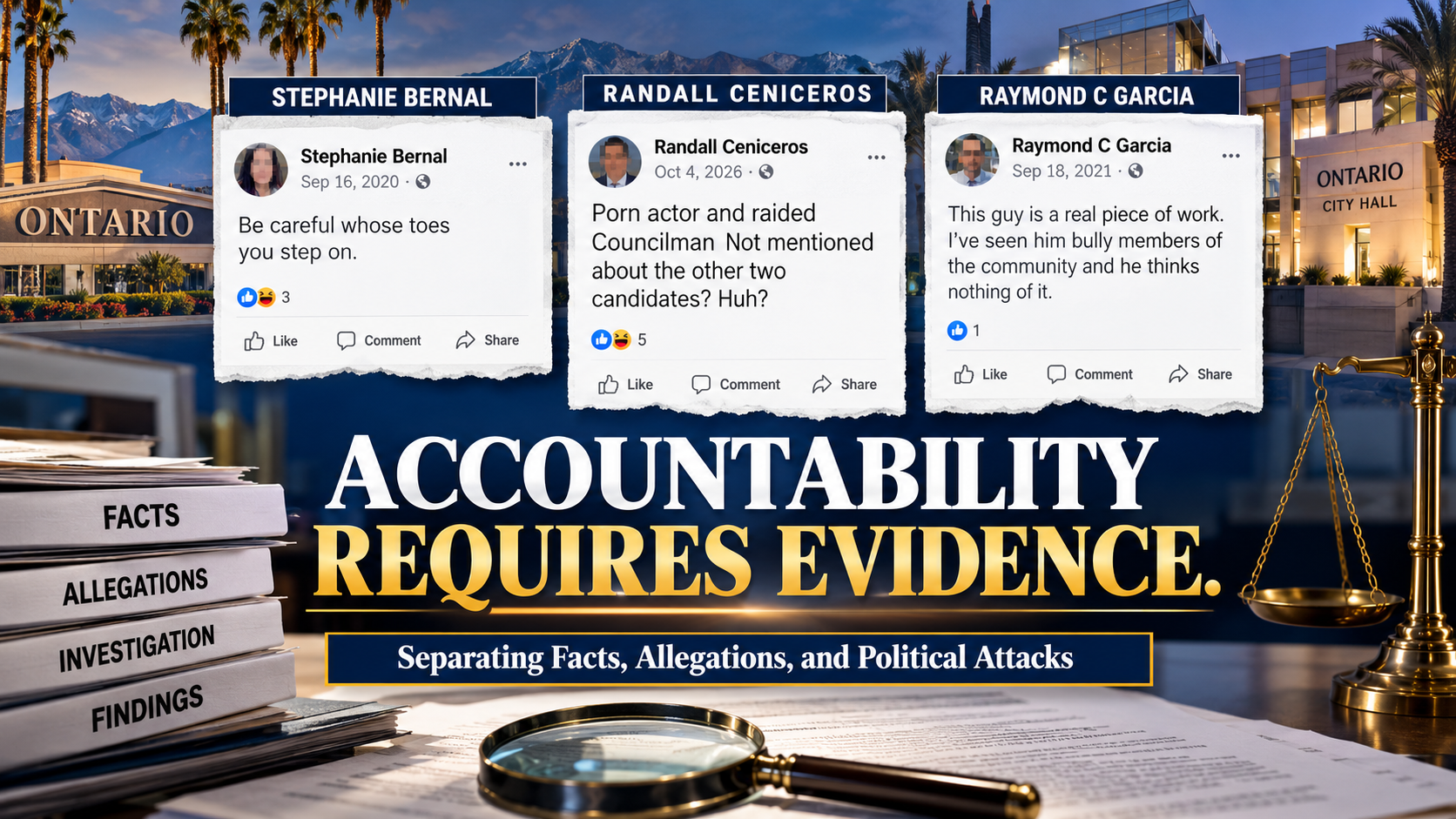
For more than a decade, D'Andre Lampkin has served on the Creekside West HOA Board. Recent events raised a broader question: when business relationships intersect with efforts to influence governing decisions, what should residents be told?

For more than a decade, I have served on the Board of Directors of Creekside West, the Ontario, California community where I live.
That service began long before I became a candidate for City Council.
Over the years, I have dealt with the normal challenges that come with HOA governance: budgets, landscaping, maintenance, reserve funding, resident concerns, vendor relationships and disagreements over how a community should be managed.
Boards should be questioned. Residents should ask difficult questions. And no board member — including me — should be immune from criticism.
But transparency works both ways.
When someone repeatedly attempts to influence the decisions of a governing body, residents should also know whether that person has a professional or business relationship connected to the outcome being advocated.
That is why I believe additional context concerning Bryan Rockwell, MGR Real Estate and recent Creekside West HOA disputes deserves to be part of the public record.
Why Bryan Rockwell's Professional Affiliation Matters
Bryan Rockwell has become one of the most vocal critics of the Creekside West Board and our existing property-management operation.
During previous discussions, Rockwell advocated replacing the current property manager and promoted an alternative associated with Michael G. Rademaker.
What was not disclosed to me during those discussions was Rockwell's professional affiliation with MGR Real Estate.
MGR's own public team directory lists Bryan Rockwell as part of its organization. MGR also identifies Michael G. Rademaker as the founder and CEO of MGR Property Management, MGR Real Estate and MGR Services.
That distinction matters.
There is nothing inherently wrong with working in real estate. There is nothing wrong with believing another property-management company could do a better job.
The issue is disclosure.
If someone is asking a governing board to replace an existing vendor with an organization connected to that person's professional network, the people being asked to make that decision should know about the relationship before evaluating the recommendation.
I am not alleging that Rockwell would personally receive a commission, payment, kickback or other financial benefit if Creekside West changed property-management companies. I have no evidence establishing that, and it would be irresponsible to claim otherwise.
The issue I can document is much narrower:
A professional affiliation existed. A management change was advocated. That affiliation was not disclosed to me while the proposal was being advanced.
Rockwell Is a Resident — But Not an HOA Member
There is another distinction that is important for readers outside Creekside West to understand.
Verified property and Association records confirm that Rockwell resides within Creekside West but is not an owner of record and is not an HOA member.
That does not mean he has no right to express an opinion. Residents should be able to speak about the communities in which they live.
But formal HOA membership matters when someone moves beyond expressing an opinion and repeatedly attempts to influence Association governance, vendor selection and meetings involving homeowners whose property and assessments are directly affected by those decisions.
This is not about exposing the private affairs of an HOA member.
It is about explaining the conduct of an individual who has repeatedly attempted to influence Association decisions while not holding the same formal membership status as the homeowners making those decisions.
This Did Not Begin During the 2026 Election
I recently recovered a Creekside West complaint submitted by Rockwell on November 10, 2017.
The complaint concerned my home.
Rockwell questioned the number of exterior security cameras at my residence and alleged that they violated the Association's governing rules.
But he went considerably further than an ordinary architectural complaint.
He suggested that the Association should "keep an eye on this house" and compared homes with multiple security cameras to drug dealers using surveillance equipment to watch for police raids or rival dealers.
I had largely forgotten about that complaint until recently locating the original record.
Its significance is straightforward:
Bryan Rockwell's scrutiny of me personally did not begin with my City Council campaign.
It predates this election and the current Creekside controversy by almost nine years.
That does not mean every disagreement we have today is illegitimate. It does, however, provide important historical context when evaluating the increasingly personal nature of his recent criticism.
What Happened at Creekside West HOA Meetings
During 2026, Creekside West meetings became increasingly contentious.
Rockwell repeatedly participated in meetings despite not being an HOA member. Concerns arose regarding disruptions, interruptions of homeowners attempting to speak and his involvement in Association matters despite lacking a formal ownership interest.
Eventually, HOA legal counsel provided Rockwell notice that he was no longer permitted to attend Association meetings.
That action did not prohibit criticism of the Board.
It addressed conduct at meetings.
There is a meaningful difference between disagreeing with leadership and interfering with the ability of homeowners to participate in their own governing process.
And throughout these disputes, I have repeatedly been portrayed online as though I personally control Creekside West.
I do not.
I am one member of a multi-member Board of Directors.
I do not independently hire or fire property managers. I do not personally establish the Association budget. I do not unilaterally appoint delegates. I do not individually determine Association policy.
Those decisions belong to a governing body operating under bylaws, CC&Rs and California law.
When Online Narratives Become Self-Reinforcing
The same pattern has appeared on social media.
In one Nextdoor discussion, Rockwell criticized me and suggested that because I was a Nextdoor Lead, I would probably have his comments removed before residents had an opportunity to see them.
There was a fundamental problem with that accusation:
I did not possess the moderation authority he was suggesting I had.
I did not remove his comments.
I did not have his post taken down.
Shortly afterward, Rockwell's comments and post disappeared from Nextdoor.
I do not know who removed them.
I do not know why they disappeared.
What concerned me was the narrative Rockwell had already created.
He publicly predicted that I would retaliate by removing his criticism. Then, for reasons unknown to me, the content disappeared.
Had I remained silent, the disappearance itself could easily have been presented as "proof" that his accusation had been correct.
That experience reinforced an important lesson:
An accusation repeated often enough can begin to resemble evidence — even when the underlying facts do not support it.
How the MGR Connection Came Into Focus
As questions surrounding prior property-management discussions continued, I reviewed publicly available information concerning the companies and individuals involved.
That review confirmed that Bryan Rockwell is professionally affiliated with MGR Real Estate and that Michael G. Rademaker is associated with MGR Real Estate and MGR Property Management.
That information was particularly relevant because Creekside West's property manager had previously recalled Rockwell advocating for someone named Rademaker during discussions about replacing the Association's existing property-management company.
These relationships do not prove wrongdoing or improper coordination. Their significance is that a professional affiliation relevant to a vendor recommendation existed but had not been disclosed to me while the management change was being advocated.
This does not establish a conspiracy.
It does not establish that MGR improperly sought Creekside West's business.
It does not establish that Michael G. Rademaker and Bryan Rockwell coordinated any effort concerning our HOA.
What it does establish is that professional relationships existed that were relevant to a management proposal — relationships that I had not previously understood.
Why the Economic Relationship Also Matters
Another issue deserves careful consideration.
Bryan Rockwell is professionally affiliated with MGR Real Estate, while his wife is a dues-paying member of the Creekside West HOA. If Creekside West had entered into a property-management agreement with an MGR-affiliated company, Association assessments collected from homeowners — including from Rockwell's household — would have been used to compensate an organization within his professional network.
That does not establish that Rockwell personally would have received a commission, bonus, salary increase, or other direct financial benefit from the contract. I do not have evidence establishing that, and I am not making that allegation.
But the professional relationship itself was relevant information.
When someone advocates that a governing body replace an existing vendor with an organization connected to that person's employer or professional network, the decision-makers should know about that relationship before evaluating the recommendation.
Verified property and HOA records also show that Rockwell himself is not an owner of record and is not an HOA member, while his wife holds the formal membership interest.
I am not speculating publicly about why the property is titled that way.
The relevant point is that Rockwell was attempting to influence vendor selection within an Association in which his household has a direct financial obligation through HOA dues, while he also maintained a professional affiliation with the organization connected to the management alternative he was advocating.
That combination does not prove wrongdoing.
It does, however, strengthen the case for full disclosure.
Transparency is not about assuming improper motives. It is about making sure governing bodies know the relationships that may be relevant before they make decisions involving contracts, vendors, public money, or homeowner assessments.
The Connection to Property Management
This is precisely why disclosure matters.
Transparency does not mean businesses, developers, real-estate professionals, contractors or property managers should be excluded from civic participation.
Quite the opposite.
Businesses have valuable expertise. Developers build communities. Property managers provide essential services. Real-estate professionals understand markets in ways many residents and public officials do not.
The problem arises when decision-makers do not know who is connected to whom while recommendations are being made.
Good governance requires basic questions:
Who is advocating for this decision?
What are they asking the governing body to do?
Do they have a professional, financial or organizational relationship connected to the outcome?
Disclosure does not automatically make a proposal improper.
It allows the people responsible for making the decision to evaluate it with their eyes open.
Why This Matters Beyond Creekside West
Readers who do not live in Creekside West might reasonably ask why any of this matters to them.
Because this article is not ultimately about an HOA.
It is about governance.
The same principles that protect homeowners in an HOA boardroom protect residents at City Hall.
Real-estate companies, developers, consultants, contractors, labor organizations, nonprofits and other interests all have the right to advocate before government.
The issue is not whether they participate.
The issue is whether the public understands the relationships behind that participation.
Ontario is a growing city. Billions of dollars in development, infrastructure, housing, commercial real estate and public investment will continue to shape its future.
Residents should be able to understand who is advocating for those decisions, who stands to benefit from them and what relationships exist among the people attempting to influence their government.
That is not anti-business.
It is pro-transparency.
One of the Reasons I Chose to Run
Experiences like this are one of the reasons I decided to run for public office.
I have seen firsthand how easily decision-making can become clouded when relationships, business interests and influence are not fully disclosed.
Whether the setting is an HOA boardroom or City Hall, residents deserve to know who is influencing decisions, what interests are involved and why decisions are being made.
For me, transparency is not a campaign slogan.
It is a lesson I have learned through years of actually serving on governing boards, listening to residents, evaluating competing interests and being willing to ask uncomfortable questions when something does not look right.
Good governance depends on disagreement.
It depends on competition.
It depends on people bringing different ideas to the table.
But it also depends on disclosure.
Transparency From the HOA Boardroom to City Hall
No developer, contractor, consultant, property manager, politically connected individual — or elected official — should expect influence simply because they know the right people.
Residents should be able to see the relationships.
They should be able to evaluate the facts.
And then they should be able to decide for themselves whether the decisions being made truly serve their community.
That is the standard I believe residents deserve — from the HOA boardroom all the way to City Hall.
My record of public service and my approach to responsible governance reflect that standard. So does my work as an Ontario Planning Commissioner — a role that required evaluating development proposals, weighing competing interests and asking the same basic question every time: who benefits, and does the public know?
Residents who believe good government begins with transparency can learn more about my approach to accountability, responsible growth and public service throughout this website.
Explore Topics
Written by
D'Andre D. Lampkin
Content creator and writer sharing insights and stories.